Showing posts with label sari draping style. Show all posts

Different Ways to Drape a Sari

Friday, December 7, 2012

| | | Comments: (0)

Before you Start

Two essential parts of attire, that go along with the Saree, need to be chosen carefully to compliment the Saree. These are:


A petticoat which is a waist-to-floor garment, tied tightly at the waist by a drawstring. The petticoat color should match the base sari color as closely as possible. No part of the petticoat, of course, is visible outside the saree, after having worn it.

A blouse which needs to be tight-fitting and whose color needs to be chosen keeping the look of the saree in mind, can be short sleeved or sleeveless, with a variety of necklines. The blouse ends just below the bust.


Wearing a Saree the Traditional Way

* Step 1. Around your body. Starting at the navel, tuck the plain end of the saree into the petticoat and continue tucking till you take a complete turn from right to left. Adjust the lower end of the saree to the height required. Ideally wear your footwear so that you drape the saree to the right length.

* Step 2. Measuring the pallu. Hold the top edge of the saree where the pallu is and bring it around your hips to the front and over your left shoulder, thus measuring the length of the pallav or pallu. The pallav should hang down the back to the knee. You may pin your pallu to your sari blouse provisionally.

* Step 3. Making pleats. Create pleats with the saree. Make about 7 to 10 pleats and hold them up together so that they fall straight and even. Tuck the pleats into the waist petticoat slightly to the left of the navel, taking care to see that the pleats are turned towards the left.

* Step 4. The pallu. The remaining portion of the saree must be turned once around the body and then draped over the left shoulder. Arrange the pleats on this part of the saree and then pin them up on the left shoulder to prevent the pallu from falling off.

This is the most common saree draping styles. With matching bindi and jewellery you feel like a complete Indian woman.




How to drape a saree, Wear Saree - Sakhi Beauty

Friday, November 23, 2012

| | | Comments: (1)
The success of the Saree is attributed to its simplicity, comfort, and a sense of luxury a woman experiences when she wears one. A properly draped Saree (sari) makes woman more graceful, stylish, elegant and sensuous.


A perfectly draped sari makes personality but a clumsily draped sari can equally bring down the look of the Sari and spoils the whole appearance of the woman. So just make a note on some basic steps about how to drape a sari in different styles.
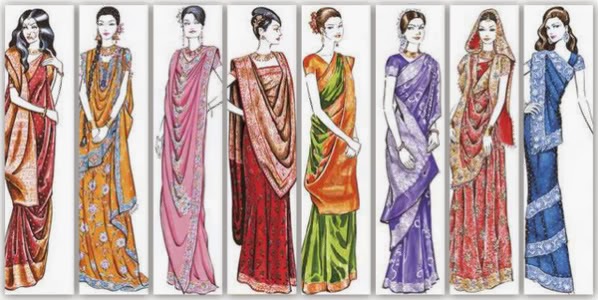
Sari is worn on different occasions and thus there are number of sari drapping styles available. For example, if you are going to an office its advisable to pin up your sari, this looks smart and is manageable too. We understand how important it is to know how to wear sari in proper style thus we explain you how to wear a sari in different styles with illustrated demonstrations in different steps.


Different ways of wearing a Sari :
The style of sari draping as explained below is the most popular style of sari draping. In this style of sari draping, one end of the sari is neatly tucked into the band of the petticoat on the waist. After wrapping the sari cloth around the waist once more, the sari is neatly folded into pleats, which are then tucked into the waistband of the petticoat just below the navel. Then after wrapping it around the body one more time, the other decorative end of the sari also called the “pallu” comes diagonally in front of the torso and draped over the left shoulder.
Gujrati Style: This style of sari draping is very similar to the above-mentioned style with the only difference being that in this style, the “pallu” or the decorative end of the sari is draped over the right shoulder rather than the left shoulder. Also, in this style the pallu is draped from back to front and not like the above in which the pallu is draped front to back.
Maharashtrian Style: This style of sari draping is very similar to the way the Maharashtrian dhoti is worn. This style of sari draping is common among the Brahmin women especially in Maharashtra, Karnataka, Andhra Pradesh and Tamil Nadu. This sari is draped in a way that the center of the sari is neatly placed at the back of the waist and the ends of the sari are tied securely in the front, and then the two ends are wrapped around the legs. The decorative ends are then draped over the shoulder and the upper body or torso.
Dravidian Style: This sari draping style is common in the state of Tamil Nadu. The archetypical Dravidian sari is the “veshti-mundanai”, which is draped in two parts: The veshti covers the lower body, while the mundanai, or mundu, is an add-on to the veshti. The draping of the veshti is fairly simple as it draped like a towel around the waist and is usually 4 yards in length. This is then folded in half lengthwise. The mundunai is usually one yard in width and two yards in length.